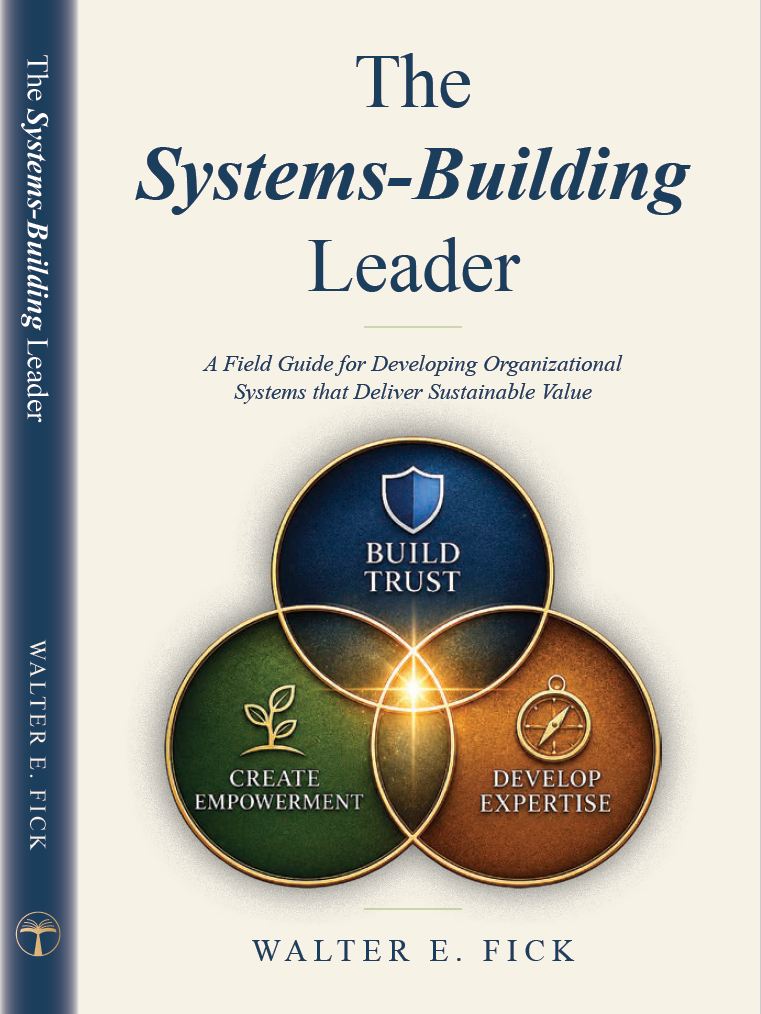
Building trust makes the organization safe.
Developing expertise makes it capable.
Creating empowerment makes it generative.
The three together produce something that none of them produces alone.
If you left tomorrow, what would your organization be able to do that it couldn't do before you arrived?
"I am exceptionally hard on leadership books. They tend to be repetitive, anecdotal, and overconfident. This one is different. It is structural, it is practitioner-grounded, and the ground it covers is immediately recognizable from every organization I've worked in."
- M. Marion, Operations Leader
"Fick treats organizational leadership as a structural engineering problem rather than a study in personality. What sets this book apart is the diagnostic framework. Systems-Building Leader forces you to think and provides sound, actionable guidelines for improving organizational excellence."
- Dr. B. Stout, College Administrator/Retired Army Officer
_mp4.jpg)
Paperback, Hardback, eBook & Kindle versions now available!
What this book is
The Systems-Building Leader is a field guide for leaders who are serious about the difference between performing well and building something that lasts.
Its three pillars of trust, expertise, and empowerment aren't motivational concepts. They're structural conditions that either exist in how your organization operates, or don't exist at all.
Eighteen chapters. Eighteen diagnostic tools. The book is built to be used, not read passively. The leader who reads one chapter and runs its tool on a real problem next week will produce more value than the leader who reads all eighteen chapters and waits for the right conditions to begin.
There are no right conditions. There is only the work.
What this book Builds
This book’s premise is straightforward: organizations do not improve because people try harder. They improve because leaders build the structural conditions that make improvement the path of least resistance.
The framework this book describes is what that work accumulates into when organized into three pillars that address the gap between intention and design.
What Empowerment Builds
What Trust Builds
Part One makes the case that trust is an engineering problem. Not a personality trait, not a relational achievement, but a designed condition that either exists in the structure of how the organization operates or does not exist at all.
What Expertise Builds
Part Two makes the case that expertise is not the same as intelligence. The intelligent leader who hasn't built the structural disciplines of systems thinking, metrics governance, uncertainty judgment, operating cadence, and executive calibration is producing results that depend on their personal cognitive engagement with every significant problem. When they step back, the results degrade. When they scale, the intelligence doesn't replicate. When they leave, the capability leaves with them.
Part Three makes the case that empowerment is not delegation. The leader who announces empowerment without building the structural conditions for it produces a formal change in authority that produces no change in behavior, because behavior is shaped by structure and not by announcements.


"This isn't theory you read. It's diagnostic work you do. The worksheets forced me to apply the framework to my actual situation, and I found structural gaps I had been working around for years without realizing it. If you are tired of repeatedly firefighting the same problems, this is the book."
- M. Klinges, Relationship Manager
Paperback, Hardback, eBook & Kindle versions now available!
"Most leadership books assume you already have authority to change things. This one teaches you to see the structural patterns first, regardless of where you sit in the organization. Anyone who has worked in an organization for any length of time will see themselves and the people around them on these pages."
- N. Zirk, Business Analyst
Leave your email and be notified when new resources become available.