Start Here
Most leaders picking up this book can’t start at the beginning and work methodically to the end. They’re in the middle of something. If any of that fits where you are, start where the problem is.
If your team depends too much on your personal presence
Start with Chapter 2 (Stewardship) and Chapter 14 (System Design). These two chapters and their tools address the working-in versus working-on distinction and the five structural conditions that produce dependency. Use Tool #2 and Tool #14 before reading anything else.
If accountability feels inconsistent or you find yourself adding oversight
Start with Chapter 3 (Accountability). Tool #3 is the most frequently used diagnostic in this book. Most leaders who complete it honestly will find at least one clarity gap they had attributed to a performance problem.
If your team is capable but not speaking up, or your meetings feel smooth but uninformative
Start with Chapter 5 (Psychological Safety) and Chapter 4 (Communication). Read them in that order. Tool #5’s ten-second response question is the single most diagnostic question in the book.
If you have announced empowerment and nothing changed
Start with Chapter 13 (Empowerment Is Not Delegation). Tool #13 will identify which of the three preconditions is missing. The answer will point you to the specific chapter in Part Three that addresses it.
If a change you launched is reverting
Start with Chapter 17 (Reinforcement Loops). Tool #17’s resistance diagnosis will identify whether you are facing a capability gap, a clarity gap, or a conviction gap. Each requires a different response.
If you are not sure where to start
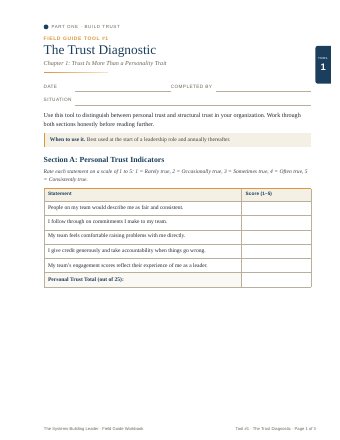
Complete Tool #1 (The Trust Diagnostic) and Tool #7 (The Expertise Self-Assessment). Together they take about forty-five minutes and will surface your highest-leverage gap more reliably than any other entry point.