Reader resources for The Systems-Building LeaderFind your starting point ↗

Reader resources for The Systems-Building LeaderFind your starting point ↗
5
Part One · Build Trust
Don’t mistake smooth meetings as evidence of alignment. They are sometimes evidence of the opposite.
Smooth meetings are not evidence of alignment. Psychological safety is about making honesty cheaper than silence, and leaders build it in the moments after someone speaks. The chapter names five behaviors that build it and shows why safety and high standards are not in tension.
Safety is about making honesty cheaper than silence.
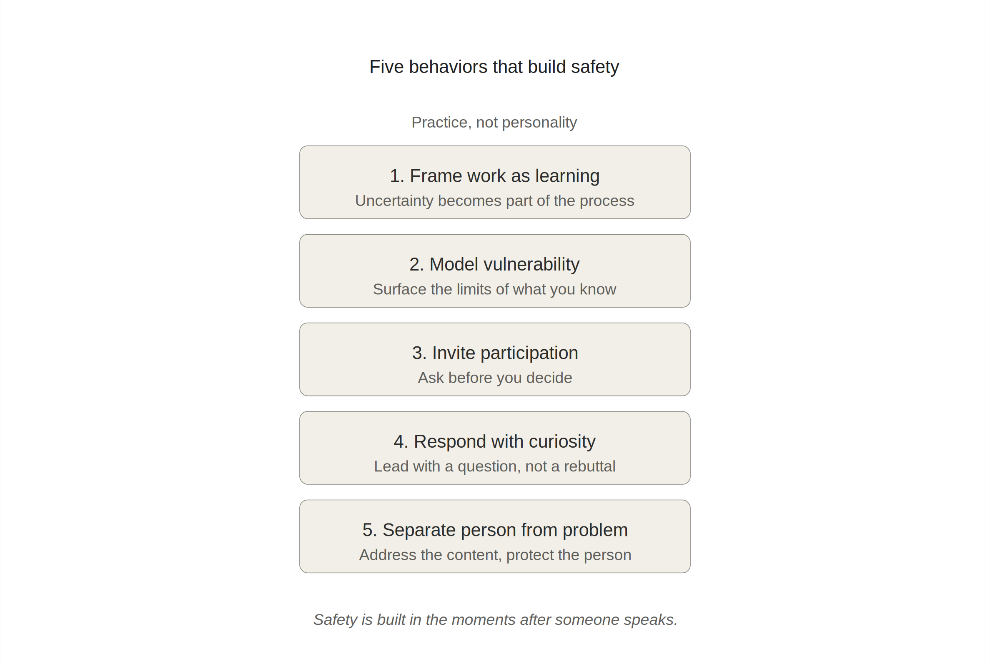
Five behaviors that build safety
Field Guide Tool #5
Assesses the current state of psychological safety through climate indicators, leader behavior questions, and the signal audit. Includes the specific ten-second response question.
Best used after a difficult team dynamic or before a major change.
Go deeper
Reading as a team?
This chapter is part of Session 2 of the Team Reading Guide.